HVAC Marketing Contract Red Flags: Read These 10 Lines Before You Sign
The short answer
Before signing an HVAC marketing contract, find ten things: who owns the ad accounts, who owns the website, the term and notice period, whether the fee is flat or a percentage of spend, what counts as a lead, whether you get the search terms report, what happens to the data when you leave, auto-renewal language, setup fees, and what the agency can do without your approval. The right answers are you, you, month-to-month, flat, a real call or form, yes, you keep everything, no silent renewal, little or nothing, and nothing that costs money.
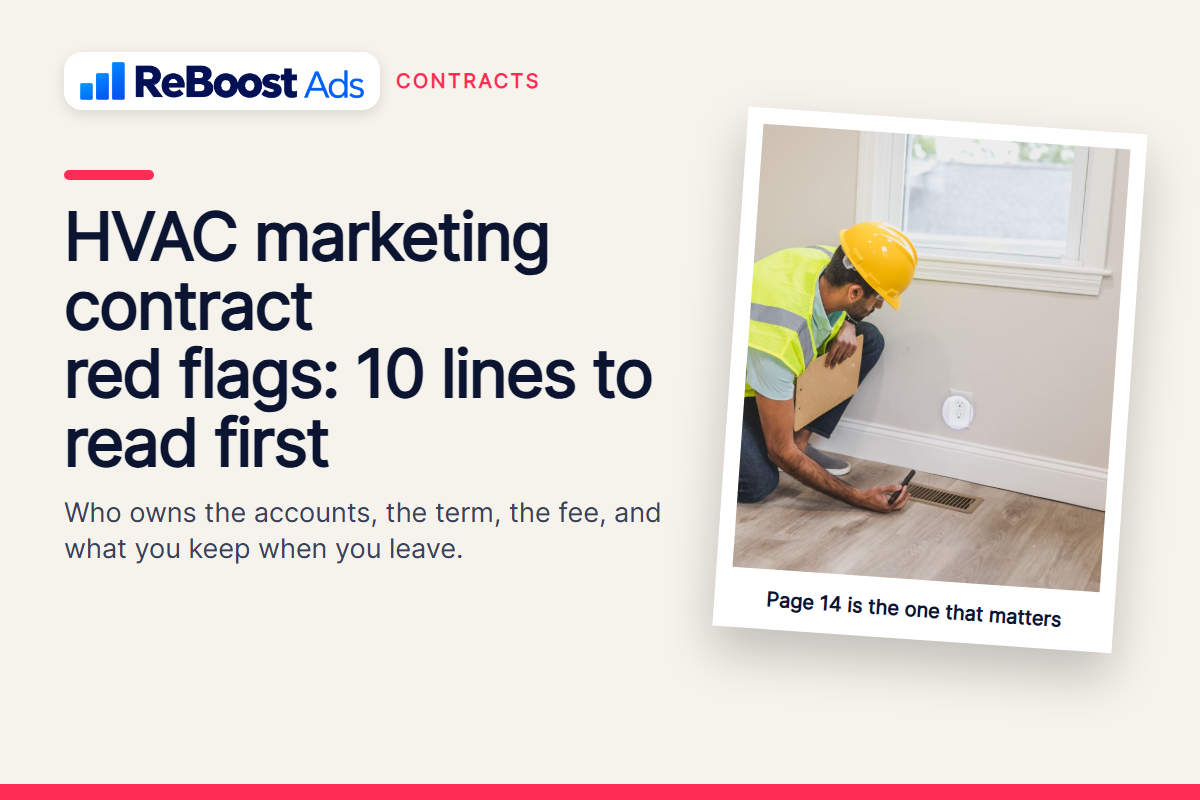
The proposal is 14 pages. Twelve of them are about the agency. Page 13 is the price. Page 14 is the part nobody reads, and it is the only part that matters, because it decides whether you own anything when this is over and how much it costs to leave. Here are the ten lines to find in any HVAC marketing contract before you sign, what each one should say, and the wording that should make you close the folder.
The short answer
Before signing an HVAC marketing contract, find ten things: who owns the ad accounts, who owns the website and content, the term and the notice period, whether the fee is flat or a percentage of spend, what counts as a lead, whether you get the search terms report, what happens to the data when you leave, auto-renewal language, setup fees and what they buy, and what the agency can do without your approval. The right answers are: you, you, month-to-month or 30 days, flat, a real call or form, yes, you keep everything, no silent renewal, little or nothing, and nothing that costs money. Anything else is a red flag, and three of them together is a different agency.
Red flag 1: the ad accounts are not in your name
What to look for: "Agency will create and manage advertising accounts on Client's behalf." What it means: the Google Ads and Meta accounts, with all the conversion history, keyword lists and negatives, belong to them. Leave and you start from zero. What it should say: accounts are created in the client's name, on the client's payment method, and the agency is granted manager access. Hook, one large agency and another agency all put "you own your accounts" in writing; it is a known standard, not a favor. (one HVAC agency; another agency.) The deeper version of this problem is in who owns your Google Ads account.
ReBoost Ads does this for you.
You pick the HVAC job you want more of. ReBoost Ads builds the Google and Facebook ads and the matching landing page in your own ad accounts, our team watches them every day, and every lead goes to your phone the second it lands. Flat $197 a month right now (year-end special, normally $297), 14-day free trial, no setup fee.
Red flag 2: the website lives on their platform
What to look for: "Website is provided as a service and hosted on Agency's proprietary platform." What it means: the site, the pages, the blog posts, the reviews widget, all of it is rented. Cancel and the site goes dark or stays theirs. one large agency's 12-month terms with the site on their CMS are the best-known example. (one large agency.) What it should say: you own the domain, the site files and the content, and you can export them. One budget agency's line, "we never hold your website hostage," is the phrasing to look for. (a budget agency.)
Red flag 3: a 12-month term with a 60-day notice
What to look for: "Initial term of twelve (12) months, with written notice of termination required no fewer than sixty (60) days before the end of the then-current term." What it means: a bad month in February costs you through the following January, and if you forget to send a letter in October you are in for another year. What it should say: month to month, or 30 days' notice at any time. Buyers are routinely told to expect 6 to 12 month terms with 30 to 90 day notice; expect it, then refuse it. (an industry lead-cost guide.)
Red flag 4: a percentage of ad spend
What to look for: "Management fee equal to fifteen percent (15%) of monthly media spend, with a minimum of $1,000." What it means: every recommendation to raise the budget is also a raise for the agency. What it should say: a flat monthly fee that does not change with spend. The full comparison is in how much an HVAC agency retainer should cost.
Red flag 5: "lead" is not defined
What to look for: any guarantee, report or pricing that uses the word "lead" without a definition. What it means: form spam, 8-second calls and job applicants will all be leads when it is time to show results. What it should say: a lead is a phone call lasting 60 seconds or more from a number in the service area, or a form submission with a valid phone number from a homeowner requesting service. Written down.
Red flag 6: no access to the raw reports
What to look for: "Agency will provide a monthly performance summary." Nothing about account access. What it means: you see the chart they draw, never the search terms you paid for. What it should say: client retains read access to all advertising accounts and analytics at all times. If you cannot pull the search terms report yourself, you cannot audit anything; the twelve signs of an agency hiding behind the summary are in is my HVAC marketing agency ripping me off.
Red flag 7: the data and the work disappear when you leave
What to look for: "All campaign structures, keyword research, ad copy and creative assets remain the intellectual property of Agency." What it means: the negative keyword list that took six months to build, the landing pages, the ads that worked, all gone. What it should say: on termination, the client keeps all accounts, data, campaigns, ad copy, landing pages, call recordings and tracking history, and the agency will transfer admin within five business days. one large agency's "you own 100% of everything we create" is the standard. (one large agency.)
Red flag 8: automatic renewal buried in the boilerplate
What to look for: "This Agreement shall automatically renew for successive terms of equal length unless..." What it means: see red flag 3, forever. What it should say: no auto-renewal of a fixed term, or a renewal that requires your written yes. Put the notice date on your calendar the day you sign anything that has one.
Red flag 9: a setup fee that does not buy anything
What to look for: "One-time onboarding fee of $2,500." What it means: published setup fees run $0 to $3,000, and the honest ones list what the fee covers: account build, tracking setup, landing pages, call tracking numbers. (another agency.) The dishonest ones cover the agency's sales commission. What it should say: an itemized list, or no fee. Ask what you get in month one that you would not get without it.
Red flag 10: they can spend your money without asking
What to look for: "Agency may adjust media budgets and allocations at its discretion to optimize performance." What it means: the budget you agreed to is a suggestion. What it should say: the monthly media budget is set by the client and may not be exceeded without written approval; the agency may reallocate within the approved total. You should never find out about a budget change from your credit card statement.
Three that are not red flags, to be fair
- A minimum ad spend. Good agencies turn down $500 a month budgets because nothing works at that level. That is honesty, not greed.
- A clause saying results are not guaranteed. one agency states plainly that it does not guarantee results, and that is more honest than the ones promising "page one in 90 days." (one agency.) Guarantees tied to rankings or lead counts are the flag; honesty about uncertainty is not.
- A 90-day commitment. Ads need a month to learn and a month to judge. Ninety days with a clean exit after is reasonable.
The five-minute contract check
- Search the document for "own" and "ownership." Read every hit.
- Search for "term," "renew" and "notice." Write the dates on your calendar.
- Search for "%" and "percent." If it is near the word "spend," stop.
- Search for "lead." If it is never defined, ask for the definition in writing before signing.
- Search for "access." If you do not keep read access to the accounts, ask why.
Where ReBoost Ads fits
ReBoost Ads was built to pass all ten lines. The campaigns live in your own Google and Facebook accounts and the data, the ads, the landing pages and the history stay yours. The fee is flat: $197 a month right now (year-end special, normally $297), never a percentage of spend. No setup fee, no long-term contract, cancel anytime, 14-day free trial. You set the budget; nothing changes without your OK. A lead is a real call or form, sent to your phone the second it lands. And the Monday report shows the real numbers, not a summary of them. See ReBoost Ads for HVAC, and if you are weighing an agency against doing it yourself, the free Agency or DIY scorecard includes the account-ownership check and the questions to ask before you sign.
Put it to work
How to check an HVAC marketing contract in five minutes
Search for own and ownership
Read every hit. Accounts, website, content and data should be yours.
Search for term, renew and notice
Write the dates on your calendar. Refuse silent auto-renewal and long terms.
Search for percent and lead
A fee near the word spend is a red flag. The word lead must be defined.
Search for access and approval
You keep read access to all accounts, and no budget changes without your written OK.
Common questions
Frequently asked questions
What should an HVAC marketing contract say about account ownership?
That the Google Ads and Meta accounts are created in the client's name, on the client's payment method, with the agency holding manager access, and that the client keeps all accounts, data, campaigns, ad copy, landing pages and tracking history on termination.
Is a 12-month HVAC marketing contract normal?
Common, but not something you have to accept. Confident agencies offer month-to-month or 30-day notice. A 12-month term with 60-day notice means a bad month costs you the rest of the year, and silent auto-renewal makes it worse.
Should an HVAC marketing agency charge a percentage of ad spend?
No. A percentage fee means the agency earns more every time it recommends a bigger budget. Insist on a flat monthly fee so the rest of the money goes into clicks.
How should a marketing contract define a lead?
A phone call of 60 seconds or more from a number in your service area, or a form submission with a valid phone number from a homeowner requesting service. If the word is undefined, spam and job applicants become leads when it is time to show results.
Are setup fees in HVAC marketing contracts a red flag?
Only when they are not itemized. Published setup fees run $0 to $3,000. Ask what the fee buys that you would not get in month one anyway, and get the list in writing or get the fee removed.