How to Spot Fake Lead Reports From a Marketing Agency
The short answer
A fake lead report is rarely a lie. It is a definition. Lead gets defined as anything the agency can count: a click, a form view, a 10-second call, a spam submission, a repeat caller, a job applicant. The test is simple: ask for the list of leads with names, phone numbers and what they wanted, and match it against your schedule. If the agency cannot produce the list, the number is decoration. ReBoost Ads sends you every lead as it lands, with the name, number and message, so the count and your phone always match.
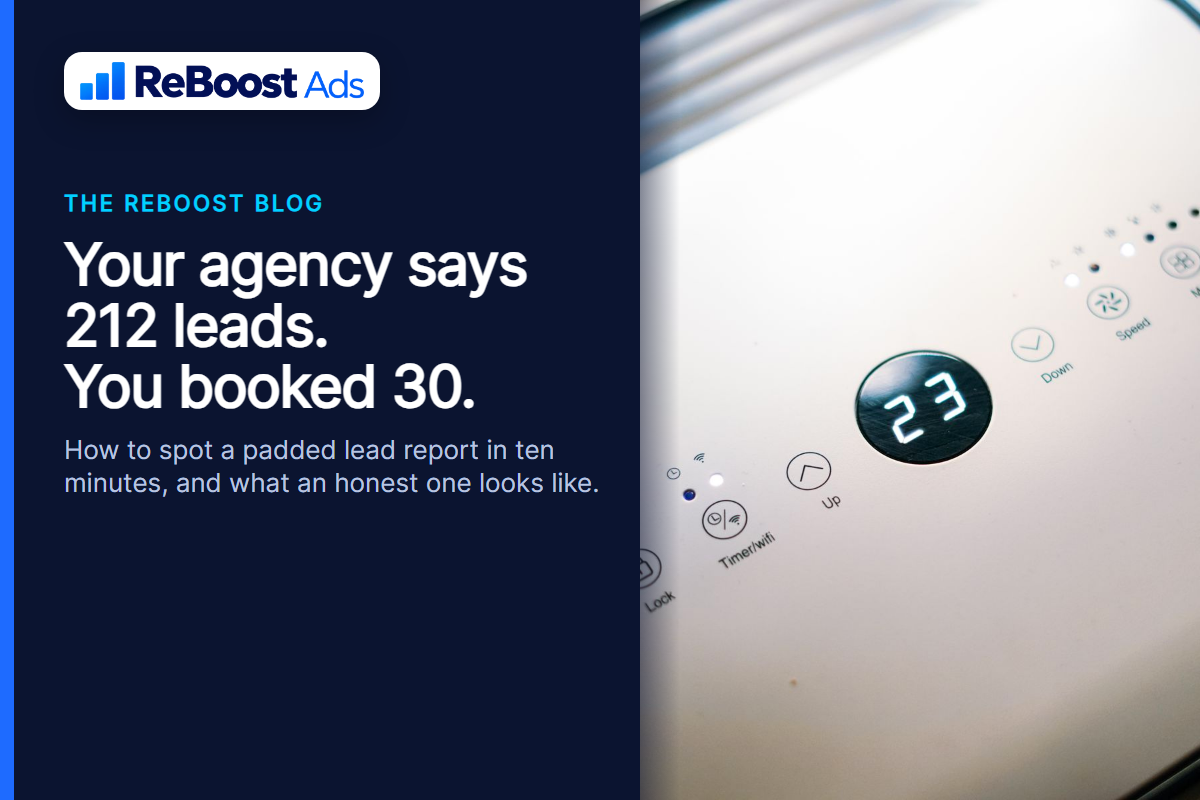
The report says 212 leads this quarter. Your office booked maybe 30 jobs from marketing in that time, and half of those came from referrals. Somewhere between the agency's spreadsheet and your schedule, 180 leads evaporated. They did not evaporate. They were never leads. This is how to tell when a marketing agency's lead report is counting things that are not customers, how to catch it in ten minutes, and what a real report looks like.
The short answer
A fake lead report is rarely a lie. It is a definition. "Lead" gets defined as anything the agency can count: a click, a form view, a 10-second call, a spam submission, a repeat caller, a job applicant, a vendor. The number goes up and the invoice gets paid. The test is simple: ask for the list of leads with names, phone numbers and what they wanted, and match it against your schedule. If the agency cannot produce the list, the number is decoration. ReBoost Ads sends you every lead as it lands, with the name, number and message, so the count and your phone always match.
The seven ways a lead report gets inflated
1. Clicks counted as leads
The oldest trick. A "lead" is anyone who clicked the ad and reached the landing page. At $9 a click that is a lot of leads and no calls. If the report has a lead number but no phone numbers, start here.
2. Every call counted, including the 8-second ones
Call tracking records every ring. A wrong number, a telemarketer, a parts supplier, a tech calling the office line, all "calls." A real report filters calls under 60 seconds and lets you listen to the rest. If you have never heard a recording, ask why.
3. Spam forms
Bots fill out contact forms all day. "SEO services for your website," "we buy houses," random strings. An honest report removes them. A padded one calls them leads.
4. Repeat contacts counted twice
The homeowner calls, then fills out the form, then calls again to confirm. One customer, three "leads." Ask whether the report de-duplicates by phone number.
5. Job seekers and vendors
If the account runs broad match, a share of the calls are people asking about jobs or trying to sell you something. They are in the call log, so they are in the count. The reason they are calling at all is in why agencies use broad match keywords on HVAC accounts.
6. Organic and referral leads credited to the ads
If the tracking number is on your Google Business Profile, your truck and your website, every call to it is a "marketing lead," including the neighbor your last customer referred. Ask which calls came from the ad campaign specifically.
7. Leads from the wrong service area or the wrong service
A call from 90 miles away about a commercial rooftop unit is a lead on the report and a wasted ten minutes in your office.
The ten-minute test
- Ask for the lead list, not the lead count. Names, phone numbers, date, what they asked for, which campaign they came from. A real system produces this in one click.
- Pick ten at random and look them up in your own records. Did they book? Did they get a quote? Did anyone in your office talk to them? If you cannot find half of them, the count is padded.
- Listen to three call recordings. If one is a vendor and one is a wrong number, you have learned what the filter is.
- Divide your real booked jobs by the reported leads. A healthy HVAC account books 30 to 50 percent of real leads. If the report implies you book 8 percent, either your office is terrible on the phone or the leads are not leads. You will know which.
What a real lead should cost, so you have a number to compare against, is in what Google Ads really cost an HVAC company in 2026.
ReBoost Ads sends you every lead the second it lands.
Name, number, what they asked for, which ad it came from, as a text to your phone. Every Monday you get a one-page report in plain words: what you spent, leads by campaign, cost per lead, what changed. The count on the report is the count on your phone, because they are the same list.
What an honest report looks like
It is short, and every number on it can be traced to a person.
- Spend, by campaign. Not just a total.
- Leads, by campaign, with the list attached. Calls over 60 seconds, forms that were not spam, de-duplicated by phone number, from your service area.
- Cost per lead, which is just the first number divided by the second.
- Booked jobs, if the agency has access to your schedule, or a line asking you for the number so they can calculate cost per booked job. An agency that never asks how many jobs you booked is an agency that does not want to know.
- What changed and what changes next week. Two sentences. If nothing changed in three months, nobody is managing the account.
That is the whole report. If yours is 14 pages, the length is doing a job, and the job is to keep you from reading it.
Why this happens, honestly
Most agencies are not crooks. They are busy, and the lead count is the number that keeps clients from leaving. Over time the definition of "lead" drifts toward whatever keeps the number up. The owner stops asking questions because the number looks fine. Then a slow month comes, the owner looks at the schedule, and the gap between 212 leads and 30 jobs finally becomes visible. The bigger question of whether the retainer is earning its keep is in how much an HVAC agency retainer should cost.
The conversation to have with your agency
You do not have to accuse anyone. Ask three questions in writing: How do you define a lead? Can I have the lead list for last month with phone numbers? Can I listen to the call recordings? A good agency answers all three within a day. A padded report cannot survive those questions, and the response you get, or do not get, tells you what to do next. If the answer is to leave, make sure the ad account comes with you; the steps are in who owns your Google Ads account.
The two numbers to put on the wall
Cost per real lead and cost per booked job. Not clicks, not impressions, not "engagement." Cost per real lead is what you paid divided by the number of people who actually wanted to hire you. Cost per booked job is what you paid divided by the jobs on the schedule. Every HVAC marketing decision, keep the agency or fire it, raise the budget or cut it, run Facebook or stop, comes down to those two numbers. An agency that reports both, every week, with the list behind them, is an agency worth keeping. One that reports neither is selling you a feeling.
Questions owners ask
What is a fair booking rate on real leads?
Thirty to fifty percent for repair and tune-up leads if the phone is answered quickly. Lower for replacement quotes, which take more visits to close. If your office is below thirty on real leads, the problem is speed to lead, not the ads.
Is a form fill a lead?
If it has a real name, a real phone number and a real request, yes. If it says "Increase your website traffic," no.
Should I ask for call recordings?
Yes, and listen to a few every month. They are the single most honest record of what your ad money is buying.
How does ReBoost Ads count leads?
A lead is a call or form from a real person in your service area asking about an HVAC job, sent to your phone as it lands. Spam, vendors and job seekers are filtered. If you ever disagree with the count, the list is right there to argue with.
What to do this week
Ask your agency for last month's lead list with phone numbers. Match ten of them against your schedule. If the match rate makes you angry, the next step is a system where the report and your phone are the same list: ReBoost Ads for HVAC, from $197 a month, 14-day free trial, in your own ad accounts.
Common questions
Frequently asked questions
How do marketing agencies inflate lead counts?
Counting clicks as leads, counting every call including 8-second ones, leaving spam forms in, counting the same customer twice, including job seekers and vendors, crediting referral calls to the ads, and counting calls from outside the service area.
What is the quickest way to check a lead report?
Ask for the lead list with names and phone numbers, pick ten at random, and look them up in your own schedule and call log. If you cannot find half of them, the count is padded.
What should an honest HVAC marketing report include?
Spend by campaign, leads by campaign with the list attached, cost per lead, booked jobs or a request for that number, and two sentences on what changed and what changes next week.
How does ReBoost Ads count leads?
A lead is a call or form from a real person in your service area asking about an HVAC job, sent to your phone as it lands. Spam, vendors and job seekers are filtered, and the Monday report uses the same list.