HVAC AI Answering Service: What It Does, What It Costs, and When to Turn It On
The short answer
An HVAC AI answering service answers the calls your office cannot: it picks up in a natural voice, asks what the system is doing, offers an appointment from your real calendar, books it, texts the homeowner a confirmation and texts you the details, and routes emergencies to your on-call tech. It is not a 24/7 obligation; the good ones turn on for the hours you choose and pause with one tap. ReBoost Voice AI is $97 a month for about 100 calls, which pays for itself the first time it books a call that would have gone to voicemail.
Here is the moment every HVAC owner knows. You are on a roof, or at dinner, or the one person in the office is on the other line, and the phone rings. It is a no-heat call. It rings out. The homeowner does not leave a voicemail; fewer than 3 percent do. She calls the next company. That was a $900 job, and in December it might have been a $9,000 one. An HVAC AI answering service is the thing that picks up that call, asks what is wrong, books the visit, and texts you the details. Here is what it actually does, what it costs, and the honest answer on when to turn it on.
The short answer
An HVAC AI answering service answers the calls your office cannot: it picks up in a natural voice, asks what the system is doing and where the homeowner is, offers an appointment from your real calendar, books it, texts the homeowner a confirmation and texts you the details, and routes emergencies to your on-call tech. It is not a 24/7 obligation; the good ones turn on for the hours you choose (after hours, lunch, weekends, when the office is out) and pause with one tap. ReBoost Voice AI is $97 a month for 300 minutes, about 100 calls, which pays for itself the first time it books a call that would have gone to voicemail.
The problem it solves, in numbers
- About 27 percent of HVAC calls go unanswered. (call-tracking industry data.)
- Only 52 percent of home-services calls reach a live person. (a 2026 home-services call study.)
- 14.1 percent of residential HVAC calls land after hours in June, with the peak from 5 to 9 pm, exactly when nobody is in the office. (industry call data.)
- 56 percent of homeowners want to book after hours and 88 percent expect a reply within 24 hours. (speed-to-lead industry data.)
- One shop that put an AI voice agent on its line reports booking more than 90 percent of 1,361 calls. (a published case study.)
The math on your own shop is in what one missed HVAC call costs. For most two-truck shops it is five figures a month.
ReBoost Voice AI picks up when you cannot.
It answers in a natural voice, asks what the system is doing, books the visit from your real calendar and texts you the details. Turn it on after hours, at lunch, on a roof, or when the office is out, and pause it any time. $97 a month, about 100 calls.
What a call actually sounds like
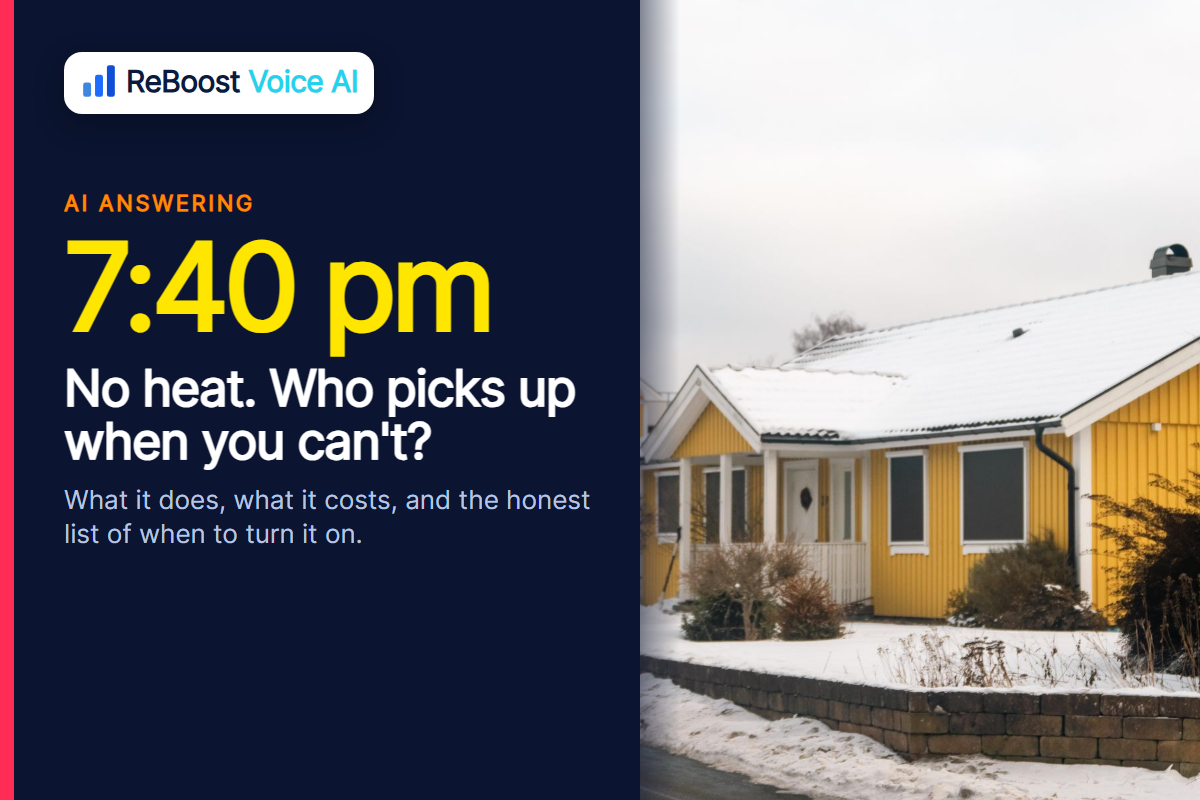
Homeowner calls at 7:40 pm. The AI answers: "Thanks for calling Summit Heating, this is the after-hours line. What's going on with your system?" She says no heat since six, the house is at 58. It asks the address and whether anyone in the home has a medical need for heat tonight (if yes, it routes straight to the on-call tech). It offers the first open slot: "I can get a technician out tonight between 8 and 9, or first thing tomorrow at 7:30. Which works?" She picks tonight. It confirms her number, texts her a confirmation, and texts you: "New job booked: furnace repair, tonight 8 to 9, Sarah K, 1847 Maple Ct, no heat since 6 pm." The call took 90 seconds. Nobody in your shop touched it.
What it is not
- Not a voicemail with a nicer voice. It books. The whole point is the appointment on the calendar.
- Not a call center in another state reading a script and taking a message that reaches you at 9 am.
- Not a replacement for your office. It takes the calls your office cannot, on the hours you pick. During business hours with a full staff, you can leave it off, or set it to pick up only when nobody answers by the fourth ring.
- Not a 24/7 contract. This is the one owners worry about most. The good ones work like a light switch: on at dinner, on for the weekend at the lake, off Monday morning. Pause it any time.
When to turn it on (the honest list)
- After hours, every day. This alone captures the 10 to 14 percent of calls that land after 5 pm.
- Lunch and the 4 to 6 pm pile-up, when the second line rings while the first is busy.
- When the office is out. Sick day, vacation, the week the dispatcher's kid has the flu.
- When you are on a roof or in an estimate and the business line forwards to your cell.
- Peak season overflow. The July heat wave when 60 calls come in and three people can answer 30.
- Not when a trained human is sitting by a quiet phone. Then leave it off and save the minutes.
How owners feel about it, honestly
Sixty-two percent of HVAC contractors now use at least one AI tool, but only 11 percent have high trust in it and accuracy is the top worry. (a 2026 contractor survey; trade press.) The owners who try it do it for hiring trouble and after-hours coverage, and the ones who keep it are the ones who treated it as coverage for the gaps, not a replacement for the personal touch. Listen to the first 20 calls it takes. You will hear it handle "my furnace is making a banging noise" better than a tired dispatcher at 5:55 pm, and you will hear the one odd call where a human should have taken it, which is why emergencies route to a person.
The questions owners ask before they try it
"What if it books something we can't do?" It only offers slots from your real calendar and only for the services you listed. It will not promise a 2 am install. If a caller wants something outside the list, it takes the details and texts you.
"What about my regulars who want to talk to Marcus?" They still can, during the hours Marcus is answering. After hours, they get the appointment they would have had to wait until morning for, and they get a text that Marcus will confirm in the morning. Regulars like that more than voicemail.
"Does it sound like a robot?" It sounds like a calm, clear receptionist. Not your cousin, not a 1990s phone tree. Most callers notice and do not care, because the thing they wanted, an appointment, happened in 90 seconds.
"What happens to the call recording?" It is saved to the customer's record in your Hub with the notes, so the tech walks in knowing it has been banging on startup since Tuesday.
What it costs, and the payback
ReBoost Voice AI is $97 a month for 300 minutes, about 100 calls, with a one-time texting registration. The Pro tier is $147 for more minutes. At an average answered call worth $300 to $900 in expected revenue, one saved call pays the month. A shop missing five calls a week pays for it in the first afternoon. Compare that to a human answering service at $1 to $2 a minute, or a second office person at $3,500 a month, who still goes home at 5.
Setup
About 15 minutes: your business name and services, your hours day by day, where emergencies go, what to ask on a call, and whether it answers always, after hours, or only when nobody picks up. Forward your line (or just the after-hours overflow) and it is live. The missed-call text-back is included, so the calls it cannot take still get a text within a minute.
Where it fits with ReBoost Ads
ReBoost Ads brings the calls: Google and Facebook ads for the HVAC jobs you want, built and run in your own accounts, watched daily, every lead to your phone instantly, flat $197 a month right now (year-end special, normally $297). ReBoost Voice AI makes sure the calls get answered when you cannot. Ads without the answer is paying to lose; the answer without the ads is a quiet phone. Together, every lead you pay for gets picked up. See ReBoost Voice AI for HVAC and ReBoost Ads for HVAC, and the free 90-day HVAC growth plan puts the phone fix at step two for exactly these reasons.
Put it to work
How to set up an AI answering service for an HVAC company
Fill in the basics
Business name, services, hours day by day, where emergencies go, and what to ask on a call. About 15 minutes.
Choose when it answers
Always, after hours only, or only when nobody picks up by the fourth ring. Change it any time.
Forward the line
Forward your business line or just the after-hours overflow. The missed-call text-back covers anything it cannot take.
Listen to the first 20 calls
Check how it handles real descriptions of problems and confirm emergencies reached a person, then leave it running on the hours that leak calls.
Common questions
Frequently asked questions
What does an HVAC AI answering service do?
It answers the phone in a natural voice, asks what the system is doing and where the home is, offers an appointment from your real calendar, books it, texts the homeowner a confirmation, texts you the details, and routes emergencies to your on-call tech. A typical no-heat call takes about 90 seconds with nobody in your shop touching it.
How much does an AI answering service cost for HVAC?
ReBoost Voice AI is $97 a month for 300 minutes, about 100 calls, plus a one-time texting registration, with a $147 tier for more minutes. Human answering services run $1 to $2 a minute and a second office person about $3,500 a month.
Does an AI answering service have to run 24/7?
No. The good ones work like a light switch: on after hours, at lunch, on weekends, when the office is out, or only when nobody picks up by the fourth ring. Pause it any time. Leave it off when a trained human is sitting by a quiet phone.
Can homeowners tell they are talking to an AI?
Often they can, and most do not mind at 7:40 pm when the alternative is voicemail. What they care about is getting a real appointment. Emergencies and odd calls route to a person, which is where the personal touch belongs.
Is an AI answering service better than voicemail for HVAC?
By a wide margin. Fewer than 3 percent of callers leave a voicemail; they hang up and call the next company. An answering service that books the appointment turns a lost call into a job on the calendar.