HVAC Missed Calls: What One Unanswered Call Costs You (With the Math)
The short answer
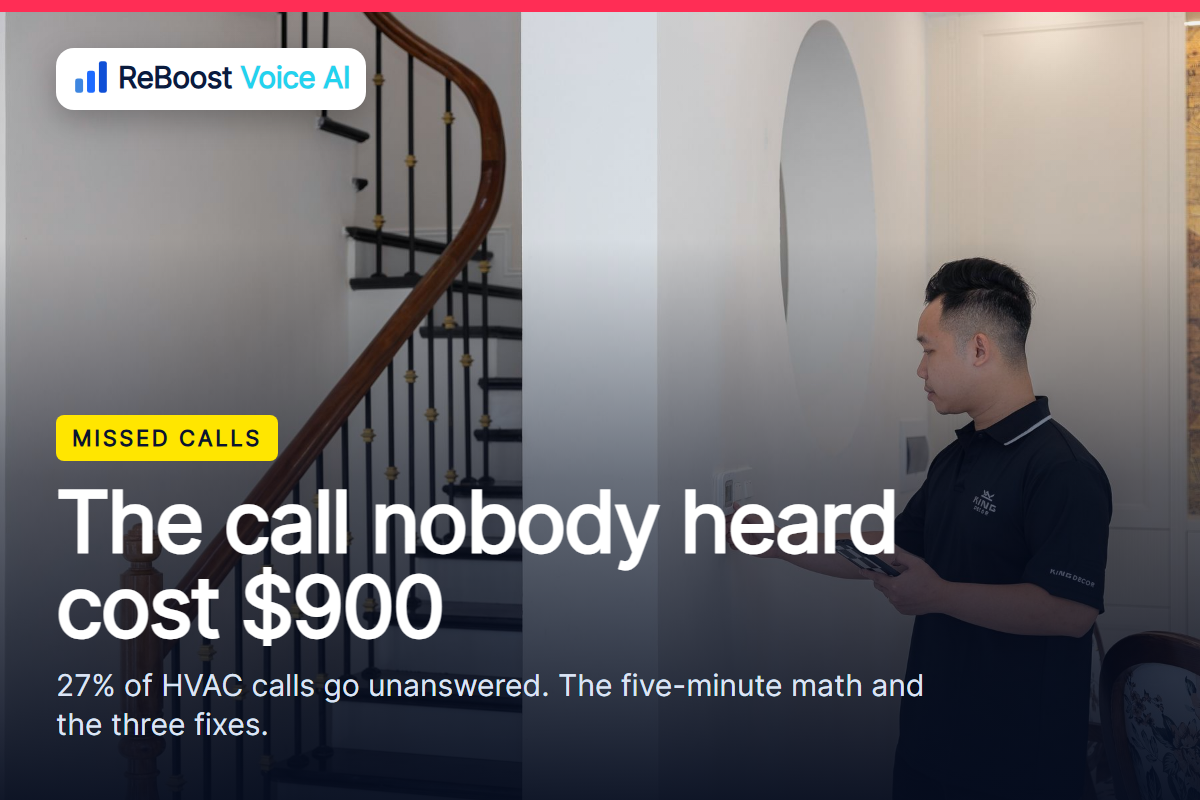
One missed HVAC call costs about $300 to $900 in expected revenue, and about 27 percent of calls to HVAC companies go unanswered, with fewer than 3 percent of those callers leaving a voicemail. Multiply your calls per day by your miss rate and by what an answered call is worth to you, and most shops land between $10,000 and $50,000 a month. Fix it in this order: automatic text-back on missed calls, an answering setup like ReBoost Voice AI for after hours and pile-ups, and instant lead routing to a phone in someone's pocket.
There is a number in your business bigger than your ad budget, bigger than your truck payment, and most HVAC owners have never written it down. It is what missed calls cost you. Not in a vague "lost opportunity" way. In dollars, per month, from calls that rang on a phone you own.
Here is how to work it out in five minutes, why it is almost always worse than you think, and the three fixes in the order they pay.
The short answer: one missed HVAC call costs about $300 to $900, and most shops miss one in four
About 27 percent of calls to HVAC companies go unanswered. (Source: call-tracking industry data.) Across home services generally, a 2026 home-services call study's 2026 benchmark found only 52 percent of calls reached a live person. (a 2026 home-services call study.) And when a caller hits voicemail, fewer than 3 percent leave a message; most hang up and call the next company. (speed-to-lead industry data.)
Put a value on the call. The average HVAC repair ticket climbed from about $818 in 2021 to about $1,205 in 2025. (a 2026 industry survey.) Not every call is a repair, and not every answered call books. Use a conservative blend: a typical inbound HVAC call is worth $300 to $900 in expected revenue once you account for the ones that would not have booked anyway. Replacement calls are worth far more.
Work out your own number in five minutes
You need three things you already know.
- Calls per day. Count a normal week on your phone system or your call log and divide by the days. Say 18 a day.
- Missed rate. Your phone report shows it. If you do not have one, use the industry 27 percent until you measure. Say 1 in 4.
- Value of an answered call. Your booking rate times your average ticket. Say you book 5 of 10 answered calls at a $900 average ticket. That is $450 per answered call.
Now multiply. 18 calls a day, 1 in 4 missed, is about 4.5 missed calls a day. At $450 each that is about $2,000 a day of expected revenue that rang and went nowhere. Over 22 working days, about $44,000 a month.
That number feels wrong the first time you see it. Run it again with your own figures. Even a two-truck shop at 8 calls a day and a 20 percent miss rate lands near $15,000 a month. This is why every field service software company on earth now leads with "stop losing calls." The leak is real, and it is bigger than any ad budget.
ReBoost Voice AI picks up when you cannot.
It answers in a natural voice, asks what the system is doing, books the visit from your real calendar and texts you the details. Turn it on after hours, at lunch, on a roof, or when the office is out, and pause it any time. $97 a month, about 100 calls.
Why it is worse in the busy season
Missed calls do not spread evenly. They stack up exactly when the calls are worth the most. Industry call data shows that in June, 14.1 percent of residential HVAC calls land after hours, versus 9.8 percent in October, with the evening peak from 5 to 9 pm. (industry call data.) Those are the no-AC-at-dinner calls and the no-heat-at-bedtime calls. They are the most urgent, the least price-sensitive, and the most likely to ring out because the office closed at 5.
Then there is the midday pile-up. The office is on one call, the second line rings, and the third caller gets voicemail. During a heat wave one Massachusetts owner described taking "60 calls a day." Nobody answers all 60.
Missed calls quietly raise your cost per lead too
If you run any paid ads, every missed call is a lead you paid for and threw away. Call-tracking data works it through: at a 27 percent miss rate, a reported $152 cost per lead is really about $208 per lead you actually spoke to. (call-tracking industry data.) The ad did its job. The click happened. Google got paid. Your competitor got the homeowner.
That is why we keep saying the phone comes before the ads. More budget into a phone that rings out is paying more to lose faster. The full cost chain is in what HVAC Google Ads really cost in 2026.
The three fixes, in the order they pay
Fix 1: text back every missed call, automatically, within a minute. This is the cheapest fix and it recovers the most. The homeowner who hung up gets a text: "This is Summit Heating, sorry we missed you. What's going on with your system? Reply here or we'll call you right back." About 78 percent of customers go with the first company that responds, and a text in 60 seconds usually is the first response. (speed-to-lead industry data.) It also catches the people who will never leave a voicemail but will happily type.
Fix 2: let something answer when nobody can. After hours, during the lunch pile-up, when the one person in the office is on the other line. ReBoost Voice AI picks up, asks what is wrong, books the visit into your calendar, and texts you the details. Emergencies go to your on-call tech. You set the hours day by day, turn it on for the evening window or the whole weekend, and pause it any time. It is $97 a month for about 100 calls, which at $450 a call is paid for by the first one it saves. Details at ReBoost Voice AI for HVAC.
Fix 3: route leads to a phone that is actually in a pocket. Form fills and ad leads should not land in an inbox someone checks at 4 pm. ReBoost Ads sends every lead to your phone the second it comes in, so the "I'll call them back" never becomes "I forgot." The handoff from inquiry to appointment is where most leads die, and how to get more HVAC leads without wasting good calls walks through fixing it.
Do them in that order. Text-back first because it is nearly free and recovers calls starting today. Voice AI second because it closes the after-hours hole. Instant lead routing third because once the phone is handled, every lead you buy is worth more.
A quick word on the "we're too busy to answer" season
Owners sometimes argue that a missed call in July does not matter because the schedule is already full. Two problems with that. First, the replacement calls hide inside the pile: the homeowner with a 19-year-old unit who was ready to buy did not get a callback and bought from the shop that answered. Second, the busy season is when your reviews get written, and "called twice, nobody picked up" is the one-star review that follows you into the slow season. The phone matters most exactly when it is hardest to answer.
What not to do
- Do not add ad budget before fixing the phone. You will pay more per booked job and conclude the ads do not work.
- Do not rely on voicemail. Fewer than 3 in 100 callers leave one. Voicemail is where HVAC leads go to die.
- Do not make it a 24/7 commitment you resent. The owners who stick with an answering setup are the ones who treat it like a light switch: on at dinner, on at the lake, off when the office is fully staffed. Not an obligation.
- Do not guess your miss rate. Measure it for one week. The number is usually higher than the owner's gut says, because the owner only hears about the ones that called back.
Put it together
Count your calls, find your miss rate, multiply by what an answered call is worth to you. Most HVAC shops land between $10,000 and $50,000 a month in revenue that rang and went nowhere. Text back the missed ones automatically, let ReBoost Voice AI pick up when nobody can, and send every ad lead straight to a pocket. Then, and only then, buy more traffic.
If you want the ads side handled at the same time, ReBoost Ads for HVAC builds and runs your Google and Facebook ads for the jobs you want, in your own accounts, and sends every lead to your phone the second it lands. Flat $197 a month right now (year-end special, normally $297), 14-day free trial, no setup fee. The free 90-day HVAC growth plan puts the phone fix at step two, before a dollar of ads, for exactly the reasons above.
Put it to work
How to calculate what missed calls cost your HVAC shop
Count calls per day
Use a normal week from your phone system or call log and divide by working days.
Find your miss rate
Read it from your phone report, or use 27 percent until you measure your own for one week.
Value an answered call
Multiply your booking rate on answered calls by your average ticket.
Multiply and fix in order
Calls per day times miss rate times call value gives the daily leak. Fix with automatic text-back first, an answering setup for after hours second, instant lead routing third.
Common questions
Frequently asked questions
What percentage of HVAC calls go unanswered?
About 27 percent, according to call-tracking industry data. Across home services broadly, a 2026 home-services call study found only 52 percent of calls reached a live person. The rate is worst in the summer evening peak and during midday pile-ups.
How much revenue does a missed HVAC call cost?
A conservative blend is $300 to $900 per missed call, based on average repair tickets around $1,205 and typical booking rates. Replacement calls are worth far more. Multiply your daily calls by your miss rate and by the value of an answered call to get your own monthly number.
Do homeowners leave voicemails for HVAC companies?
Rarely. Fewer than 3 percent of callers who reach voicemail leave a message. Most hang up and call the next company on Google, which is why voicemail should never be the plan for a missed call.
What is the fastest fix for missed HVAC calls?
An automatic text back within a minute of the missed call. About 78 percent of customers choose the first company that responds, and a text often beats a callback. After that, an answering setup for after hours and pile-ups, and routing every ad lead to a phone in someone's pocket.
Does ReBoost Voice AI have to run 24/7?
No. You set the hours day by day, turn it on for after hours, dinner, weekends, or whenever the office cannot grab the phone, and pause it any time. Emergencies route to your on-call tech. It is $97 a month for about 100 calls.