HVAC Speed to Lead: Why the First 5 Minutes Decide the Job
The short answer
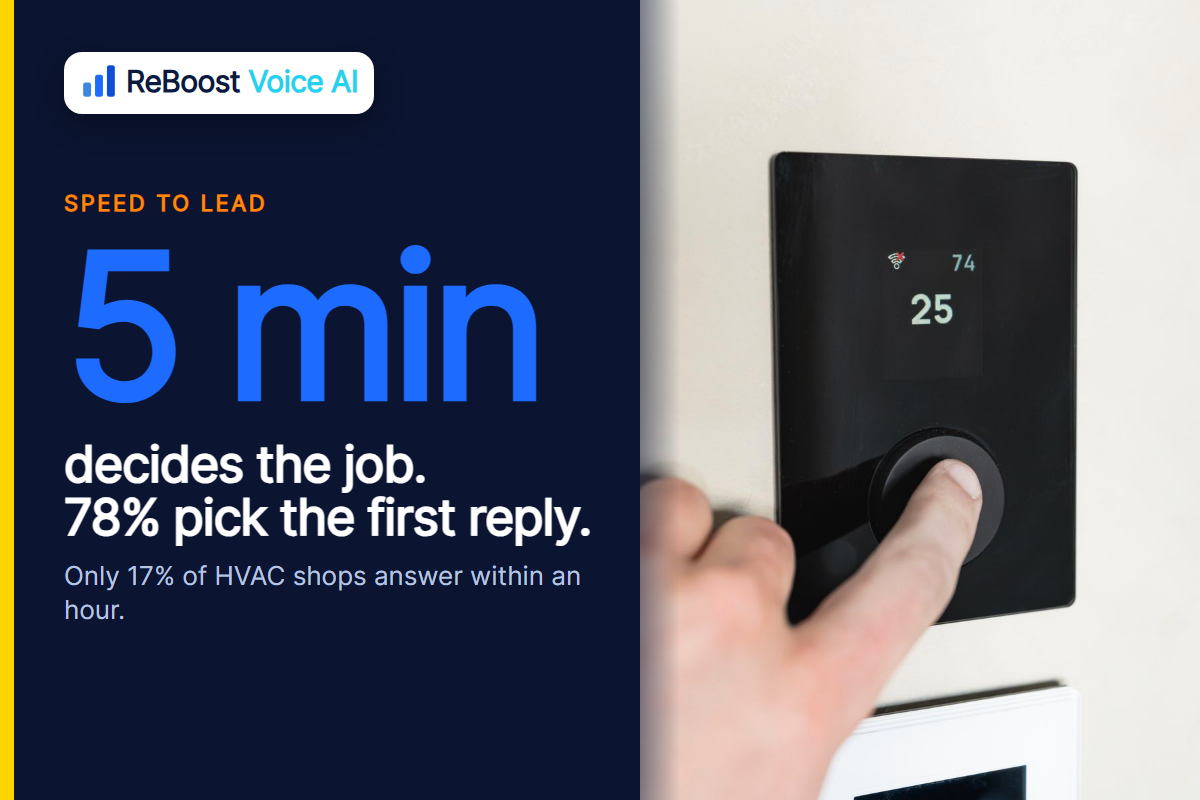
Speed to lead is how long it takes you to respond to a new inquiry, and in HVAC the first five minutes decide the job: about 78 percent of customers go with the first company that responds, only 17 percent of HVAC companies reply within an hour, and 88 percent of human follow-ups take longer than five minutes. Fix it with an automatic text within a minute of every call, form or ad lead, every lead sent to a phone in someone's pocket, something that answers after hours, and a short follow-up sequence. The same leads you already pay for will book two to three times more often.
A homeowner fills out a form on your site at 8:14 pm: "Furnace making a loud bang when it kicks on, can someone come look?" Your office sees it at 8:40 the next morning and calls at 9:15. She booked with somebody else at 8:31 pm. Not because they were cheaper or better. Because they texted her in four minutes. That is speed to lead, and in HVAC it decides more jobs than price, reviews or the quality of your ads.
The short answer
Speed to lead is how long it takes you to respond to a new inquiry, and the first five minutes decide the job: about 78 percent of customers go with the first company that responds, only 17 percent of HVAC companies respond within an hour, and 88 percent of human follow-ups take longer than five minutes. The fix is not working harder; it is an automatic text within a minute of every call, form or ad lead, every lead sent to a phone in someone's pocket, and a short follow-up sequence for the ones who do not answer. Do that and the same leads you already pay for book two to three times more often.
The numbers behind the five-minute rule
- 78 percent of customers choose the first responder. (speed-to-lead industry data.)
- Only 17 percent of HVAC companies respond within an hour; 78 percent respond "same day," which is a polite way of saying tomorrow for an 8 pm lead. (a 2026 HVAC industry survey.)
- 88 percent of human replies take more than five minutes; across 132,000 HVAC speed-to-lead campaigns, automated first texts got a 60 percent response rate and the best sequences used seven messages over five days. (speed-to-lead industry data.)
- 88 percent of homeowners expect a reply within 24 hours and 56 percent want to book after hours. (a 2026 homeowner survey, above.)
- Only 52 percent of home-services calls reach a live person. (a 2026 home-services call study.)
Put together: the lead comes in, most shops take an hour or a day, the homeowner has already moved on, and the shop that texted in a minute got the job without being better at anything but timing.
ReBoost Voice AI picks up when you cannot.
It answers in a natural voice, asks what the system is doing, books the visit from your real calendar and texts you the details. Turn it on after hours, at lunch, on a roof, or when the office is out, and pause it any time. $97 a month, about 100 calls.
Why HVAC leads die faster than most
An HVAC inquiry is a problem, not a project. The furnace is banging now. The AC is blowing warm now. The homeowner is uncomfortable and slightly panicked, and she is going to keep tapping until someone answers. A kitchen remodel lead can wait a day. A no-heat lead cannot wait ten minutes. The same is true, less dramatically, for tune-up offers from Facebook: she tapped twice while scrolling, and if you call tomorrow she does not remember tapping.
Where the time goes in a typical shop
Map your own. A form fill lands in an inbox the office checks three times a day. A missed call goes to voicemail, which fewer than 3 percent of callers use. An Angi lead pings the owner's phone on a roof. A Facebook lead sits in a Meta dashboard nobody opens. Each path has a different delay and most of them are measured in hours. The fix is one path: every lead, from every source, to one phone, instantly, with an automatic first text.
The four-part fix
1. Automatic text within 60 seconds, for every lead. Missed call, form fill, ad lead, all of them. "Hi, this is Summit Heating, we got your message about the furnace. What's it doing? Reply here or we'll call you in a few minutes." This single step is what 60 percent response rates are built on. It works at 8 pm, on a roof, and on Sunday.
2. Every lead to a phone in a pocket. Not an inbox. Not a dashboard. The owner's phone, the dispatcher's phone, the on-call tech's phone, with the homeowner's name, number and what they wrote. ReBoost Ads does this for every ad lead the second it comes in.
3. Someone or something that answers when nobody can. After hours, at lunch, during the pile-up. ReBoost Voice AI picks up, asks what is wrong, books the visit, and texts you the details; you set the hours and pause it any time. The math on what it saves is in what one missed HVAC call costs.
4. A short follow-up sequence for the ones who go quiet. Not every lead answers the first text. Day 1 a text, day 2 a call and a text, day 4 a text with a question ("still need someone to look at the furnace?"), day 7 a last text. Seven touches over five days is what the best HVAC campaigns use. After that, stop; they will come back to the shop that was easy to reach.
The first text, word for word
The automatic text does one job: it makes the homeowner feel heard in the first minute, so she stops tapping. It is not a pitch and it is not a form. Three versions that work:
Missed call: "Hi, this is Summit Heating. Sorry we missed you just now. What's going on with your system? Reply here and we'll call you right back."
Website or ad form: "Hi Dana, Marcus from Summit Heating. Got your note about the furnace banging on startup. Is it running at all right now? I can have someone out today between 2 and 4 if that works."
After hours: "Hi Dana, this is Summit Heating. We got your message. Our on-call tech will text you within 15 minutes to see if this is a tonight thing or a tomorrow morning thing."
Notice each one asks a question. A question gets a reply, and a reply is a conversation, and a conversation books. "Thanks for contacting us, we'll be in touch" gets nothing. The office then replies to every answer within five minutes during hours; after hours, the on-call tech or ReBoost Voice AI takes it from there. Write your three texts tonight. They are the cheapest marketing you will ever do.
What "fast" looks like by lead type
- Phone call, missed: text back in under a minute, call back in under five.
- Website form: text in under a minute, call in under five during hours, first thing in the morning after hours with a text the night before.
- Facebook or Instagram lead form: text in under a minute, call in under five. These go cold fastest.
- Google ad click that did not call: retarget for 14 days. You cannot text someone who did not leave a number, but you can keep showing up.
- Shared lead (Angi etc.): under 60 seconds or do not bother; three other shops got it at the same moment.
How to measure it this week
Pick last week's 20 leads from every source. For each, write down when it arrived and when the first human or automatic response went out. Find the median. Most shops that do this for the first time find a number between 45 minutes and the next business day, and a booking rate that explains itself. Then turn on the automatic text and measure again in two weeks. The booking rate on the same leads usually moves from three in ten toward five in ten, which, on the cost side, is the difference between $347 and $208 per booked job on a $104 lead. That math is in what HVAC Google Ads really cost in 2026.
Where ReBoost fits
ReBoost Ads sends every ad lead to your phone the second it comes in, with the homeowner's details, so step two is handled the day you turn it on. The campaigns are built for the HVAC service you pick, run in your own Google and Facebook accounts, watched daily, flat $197 a month right now (year-end special, normally $297), no setup fee, 14-day free trial. ReBoost Voice AI handles step three for $97 a month, on your hours. See ReBoost Ads for HVAC, and the free 90-day HVAC growth plan puts the speed-to-lead fix at week one, before a dollar goes into ads, because every lead you buy after that is worth more.
Put it to work
How to fix HVAC speed to lead in two weeks
Measure it
Take last week's 20 leads from every source, note arrival time and first response time, and find the median.
Automate the first text
Every missed call, form and ad lead gets a text within 60 seconds asking what the system is doing.
Route every lead to a pocket
Owner, dispatcher or on-call tech, with the homeowner's name, number and message, instantly.
Cover after hours and add a sequence
An answering setup for the hours nobody can pick up, and a seven-touch, five-day follow-up for the ones who go quiet. Measure again.
Common questions
Frequently asked questions
What is speed to lead in HVAC?
The time between a homeowner's inquiry (a call, a form, an ad lead) and your first response. For HVAC it matters more than in most trades because the inquiry is usually an uncomfortable house right now, and the homeowner keeps calling until someone answers.
How fast should an HVAC company respond to a lead?
Within five minutes, with an automatic text inside the first minute. About 78 percent of customers choose the first company that responds, and the best HVAC follow-up campaigns combine an instant text with a short sequence over the next few days.
What is a good response rate for HVAC lead follow-up?
Across 132,000 HVAC speed-to-lead campaigns, automated first texts averaged about a 60 percent response rate. Human-only follow-up usually lands far lower because 88 percent of human replies take longer than five minutes.
How do I respond to leads after hours?
An automatic text within a minute that asks what the system is doing, and an answering setup like ReBoost Voice AI that picks up, books the visit and texts you the details on the hours you choose. More than half of homeowners want to book after hours.
How many times should I follow up an HVAC lead?
About seven touches over five days: a text, then a call and a text, then a text with a question, then a final text. After that, stop; the ones who went quiet will come back to the shop that was easy to reach.