HVAC Calls You Miss During the Workday: The Jobs That Leave While You're on a Roof
The short answer
Most missed HVAC calls happen during business hours, not after them, because that is when most calls come in and when your people are busiest. The fix is not hiring a second office person. It is a text-back that fires the second a call is missed, answers the question the caller actually has, and books the job from your calendar while you keep working. ReBoost Voice AI does that from $97 a month, and you can turn it on only for the hours you are on jobs.
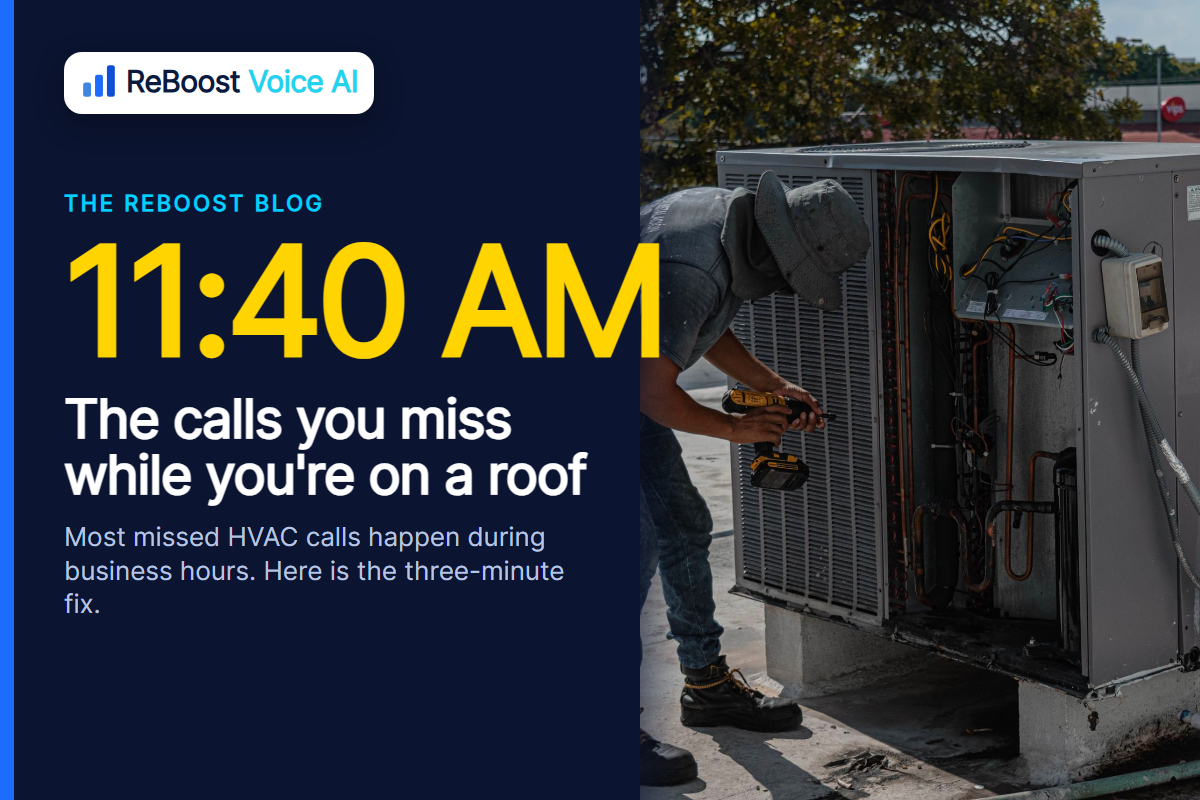
Everyone talks about the 9 PM call. Fewer people talk about the 11:40 AM one, which is the call you miss most often. You are on a roof. Your one office person is on the other line with a parts supplier. The phone rings, a homeowner wants a tune-up quote before the cold hits, and it rings out. She was not an emergency. She was a $89 tune-up that becomes a maintenance plan that becomes the replacement in three years. This article is about the daytime calls HVAC companies lose while they are busy doing HVAC work, and the cheapest way to stop losing them.
The short answer
Most missed HVAC calls happen during business hours, not after them, because that is when most calls come in and when your people are busiest. The fix is not hiring a second office person. It is a text-back that fires the second a call is missed, answers the question the caller actually has, and books the job from your calendar while you keep working. ReBoost Voice AI does that from $97 a month, and you can turn it on only for the hours you are on jobs.
What the video shows
Tuesday, 11:40 AM. The call is missed because the crew is on a job. A text goes out within seconds: sorry we missed you, the crew is on a job, what can we help with? The homeowner wants a furnace tune-up before it gets cold and asks what it costs. The reply gives the price, offers Thursday 8 AM or Friday 1 PM, and asks which works. Thursday at 8. The address is confirmed, a reminder is promised, and the job is booked at 11:43 AM. The owner is still on the roof. The job is on the calendar.
Nothing in that thread required a person. The caller wanted three things: a price, a time, and confidence that someone was paying attention. All three were delivered in three minutes, in the channel she was already holding, without a callback she might not have picked up.
Why daytime calls get missed
The after-hours call gets missed because nobody is there. The daytime call gets missed because everybody is busy. The common reasons, from shops we talk to:
- One office person, two lines. The second call rings out while the first is being handled.
- Owner-operator shops. The phone is in your pocket and your hands are in an air handler.
- Lunch. Thirty to sixty minutes a day when the office is empty and the calls keep coming.
- The office person is out. Sick days, vacations, the day they quit.
- Unknown numbers. After enough spam calls, techs stop answering numbers they do not know. Homeowners are always unknown numbers.
Industry call data puts the unanswered share at about 27 percent across all hours, and only about half of home-services calls reach a live person. The daytime share of that is bigger than the after-hours share simply because more calls come in during the day. Every one of them is a lead you already paid for with an ad, a review or a referral. The math on what each one costs is in what one missed HVAC call costs.
The daytime caller is a different customer
After-hours callers are cold and motivated. Daytime callers are often planning: a tune-up before the season, a quote on a replacement they have been thinking about, a question about a noise. They are more likely to call two or three companies. They are also more likely to leave if nobody answers, because they are not desperate; they are comparing. Speed-to-lead data says 78 percent of customers go with the first company that responds. For the daytime planner, "responds" means a text in thirty seconds, not a callback at 4:30.
That is why the text-back works better than a voicemail greeting that promises a callback. The voicemail asks her to wait. The text answers her. One of those keeps her on your calendar.
ReBoost Voice AI picks up the calls you can't.
Missed-call text-back in seconds, answers the questions you get all day, books from your calendar and sends you the details. Turn it on for the afternoon, the lunch hour, or every time the crew is on a job. From $97 a month.
What a daytime text-back has to do well
Answer the question, not just acknowledge the call
"Sorry we missed you, we'll call you back" is a voicemail in text form. The caller in the video asked a price. She got the price. If the text cannot answer the real question, she is back to comparing companies.
Offer real times
Thursday 8 AM or Friday 1 PM, from the calendar, not "someone will reach out to schedule." Choice plus certainty is what books a planner.
Confirm the details it already knows
If she has called before, the address is on file. Confirming it instead of asking for it is a small thing that makes the whole exchange feel like a company that has its act together.
Tell you
The job is not real until it is on your phone and your calendar. The text to the owner at 11:43 AM is the point of the whole thing.
Know when to stop
A gas smell or a CO alarm is not a text conversation. ReBoost Voice AI hands those to your on-call tech immediately and tells the caller what to do in the meantime. More on what it does and does not do in the HVAC AI answering service guide.
Turn it on for the hours that hurt
You do not have to hand your whole phone to it. Most shops that use ReBoost Voice AI for daytime calls use it in one of three ways:
- Overflow only. The office phone rings first. If nobody picks up by the third ring, the AI answers. The office person never notices on a quiet day and is grateful on a busy one.
- Lunch and gaps. On from 12 to 1, and whenever the office person marks themselves away.
- Crew days. Owner-operators flip it on when they leave for the first job and off when they get back to the truck.
In each case the on/off switch is yours, day by day, and nothing about it is a contract.
The money, plainly
Say you miss 8 daytime calls a week. Say 3 of them would have booked, at an average of $400 across tune-ups, repairs and the occasional quote that turns into a replacement. That is $1,200 a week, about $5,000 a month, not counting the maintenance-plan and replacement value those customers bring later. ReBoost Voice AI is $97 a month for about 100 calls. The first booked tune-up covers it. Everything after that is the reason you read this far.
Where this fits with your ads
Daytime calls are where ad money goes to die. A homeowner searches "furnace tune-up near me" at 11:30 on a Tuesday, clicks your ad at about $9, calls, and gets voicemail. You paid for the click; the next company got the job. ReBoost Ads builds and runs your Google and Facebook ads for the service you pick and sends every lead to your phone instantly, and ReBoost Voice AI makes sure the ones that come in as calls get answered and booked. If you run ads without fixing the phone, the article you want next is why your HVAC Google Ads are not working. The ads product itself is at ReBoost Ads for HVAC.
Questions owners ask
Will my office person feel replaced?
No. In overflow mode they answer everything they can, and the AI only takes what would have gone to voicemail. Most office staff describe it as finally having a second line that does not need lunch.
Can it quote prices?
It can state the prices you give it, like the $89 tune-up in the video. It does not invent prices for repairs it cannot see. For those it books the diagnostic visit and tells the caller how pricing works.
What about callers who want to talk to a person?
It offers to have someone call back and sends you the request. Most callers take the appointment instead, because the appointment is what they called for.
How fast does the text go out?
Within seconds of the missed call. The point is to reach her before she dials the next company, which is usually under a minute.
Try it on your own line this week
Call your shop at 12:15 on a weekday from a number you do not use. If it rings out, that is what every lunchtime caller gets. ReBoost Voice AI for HVAC is at reboosthub.com/hvac-answering-service, it takes a few minutes to set up, and you can turn it on for just the hours you are on a roof.
Common questions
Frequently asked questions
Why do HVAC companies miss so many daytime calls?
One office person and two lines, owner-operators with their hands in an air handler, lunch hours, sick days, and techs who stop answering unknown numbers. About 27 percent of HVAC calls go unanswered across all hours, and most of them land during the day.
What should a missed-call text say?
It should answer the caller's real question, offer two actual appointment times from your calendar, confirm details you already have, and tell the owner the job is booked. 'We'll call you back' is a voicemail in text form.
Can I use an AI answering service only when the office is busy?
Yes. Overflow mode lets the office phone ring first and the AI picks up what would have gone to voicemail. You can also turn it on for lunch, afternoons, or crew days and off when you are back.
What does ReBoost Voice AI cost?
From $97 a month for about 100 calls, month to month, with an on/off switch you control day by day.