HVAC After-Hours Calls: Who Answers at 9 PM, and What It Costs When Nobody Does
The short answer
After-hours HVAC calls are the most valuable calls you get and the least likely to be answered. Roughly 1 in 4 HVAC calls goes unanswered at any hour, and the share that lands after 5 PM climbs with every cold snap. You have four ways to answer them: you, an on-call tech, a human answering service, or an AI answering service that texts back and books the job. The last one is the only one that costs less than one missed call a month. ReBoost Voice AI does it from $97 a month, for only the hours you choose.
It is 9:14 on a Tuesday night. The house is at 58 degrees and dropping. The homeowner finds your number, calls, and gets four rings and a voicemail greeting recorded in 2019. She does not leave a message. Fewer than 3 percent of HVAC callers do. She hangs up, taps the next company, and someone else gets the $900 repair, or the $9,000 replacement that repair turns into by Thursday. This article is about that call: who is answering HVAC phones at 9 PM, what each option costs, and what it costs when the answer is nobody.
The short answer
After-hours HVAC calls are the most valuable calls you get and the least likely to be answered. Roughly 1 in 4 HVAC calls goes unanswered at any hour, and the share of calls that land after 5 PM climbs every cold snap. You have four ways to answer them: you, an on-call tech, a human answering service, or an AI answering service that texts back and books the job. The last one is the only one that costs less than one missed call a month. ReBoost Voice AI does it from $97 a month, and you can turn it on for just the hours you choose.
What actually happens at 9:14 PM
Watch the thread above. The call is missed. Within seconds the homeowner gets a text: sorry we missed you, is this an emergency or can it wait until morning? She says no heat, 58 degrees, can someone come tonight. The reply offers a 10:30 PM slot and asks for the address. She gives it. The job is booked at 9:16 PM and the details are sitting on the owner's phone when he wakes up. Total time: two minutes. Total human effort from the shop: zero.
Now play the other version. No text goes out. She calls the next company, who happens to have a person or a system that picks up. By 9:20 she has a tech scheduled and your name is gone from her phone. If the furnace is 18 years old, that competitor is also the one who quotes the replacement. One missed call at 9 PM in November is not a $120 service fee. It is often the whole relationship.
The numbers behind after-hours calls
- About 27 percent of HVAC calls go unanswered. (call-tracking industry data.)
- Only about half of home-services calls reach a live person. (a 2026 home-services call study.)
- In peak months, around 14 percent of residential HVAC calls land after hours, with the thickest cluster between 5 and 9 PM. (industry call data.)
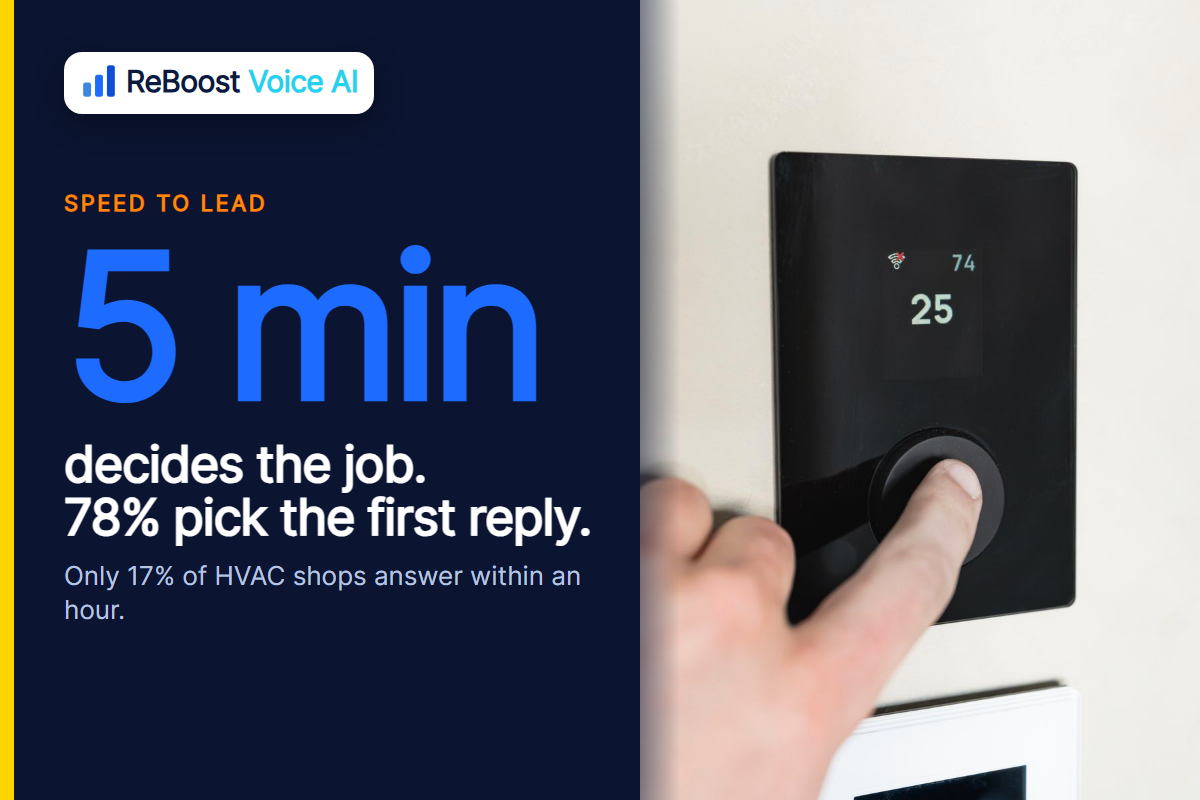
- 78 percent of customers hire the first company that responds. (speed-to-lead industry data.)
- Fewer than 3 percent of callers leave a voicemail when they are standing in a cold house.
Put those together and the after-hours call is a coin flip you are paying to lose. You paid for the ad, the website or the review that produced the call. The call came in. The job went to whoever answered. The full math on what each missed call costs a two-truck shop is in what one missed HVAC call costs.
Who answers HVAC phones at 9 PM, and what each option costs
1. You
The default. The owner's cell rings at dinner, at the kid's game, at 2 AM. It works until it does not: the night you are asleep, the week you are on vacation, the stretch where you simply stop picking up unknown numbers because you are tired. Cost: free on paper, and the most expensive option in practice, because the calls you miss are random and you never know which one was the replacement.
2. An on-call tech rotation
Better. One tech carries the phone each night. The problems are the same as yours, spread across more people: the phone gets missed on a job, the tech is not a dispatcher and books badly, and good techs quietly resent it. Cost: on-call pay or a bonus, plus turnover risk. It is still the right answer for true emergencies, which is why the good AI services send those calls straight to this person.
3. A human answering service
A call center picks up in your company name, takes a message, and forwards it. For HVAC this usually means a $150 to $400 monthly base plus per-minute charges, and the operator cannot see your calendar, so the "booking" is a note that says "wants someone tonight." You still have to call her back. By then, see the stats above.
4. An AI answering service
The phone is answered in a natural voice, the caller is asked what the system is doing, an appointment is offered from your real calendar, the job is booked, and both of you get a text. If the call is missed anyway, the text-back thread in the video kicks in. Emergencies go to the on-call tech. Cost: ReBoost Voice AI is $97 a month for 300 minutes, about 100 calls. One booked no-heat call pays for most of a year. What it does and does not do is covered in detail in the HVAC AI answering service guide.
ReBoost Voice AI answers the 9 PM call.
It picks up in a natural voice, texts back when a call is missed, books from your calendar, and sends you the details. Turn it on for after hours only, or all day while you are on a roof. From $97 a month, pause any time.
What it costs when nobody answers
Run it on your own shop. Say 40 calls come in a week and a quarter go unanswered: 10 calls. Say 3 of those would have booked at a $900 average ticket. That is $2,700 a week, about $11,000 a month, walking to a competitor. In a cold snap the ticket is higher and the share of after-hours calls is higher, so the number grows exactly when you can least afford it.
And that counts only the repair. The after-hours no-heat call is the single best replacement lead an HVAC company gets. The homeowner is uncomfortable, motivated, and standing next to an old furnace. If your competitor answers that call, they are the ones who get to say "it's 18 years old, let's talk about options." You paid to generate that lead. They closed it.
Why after-hours calls are different from daytime calls
Daytime callers are often shopping. They want a price, they will call three companies, and they will think about it. After-hours callers are not shopping. The house is cold, the kids are complaining, and the first company that says "we can be there tonight" wins. That is why the response speed matters more at 9 PM than at 9 AM, and why a voicemail greeting is the worst possible answer. It tells her, politely, to call someone else.
The text-back in the video works because it meets that urgency in the channel she is already holding. She does not have to call again. She does not have to wait. She answers a question, gives an address, and goes to find a blanket. Speed to lead has a whole article of its own in HVAC speed to lead, and the after-hours call is the sharpest version of it.
Turning it on without turning your life over to it
The worry owners raise most is losing control. The honest answer is that you set the hours. Most shops start with after hours only: 5 PM to 8 AM on weekdays, all weekend. The daytime phone keeps ringing in the office like always. If the office gets slammed or the one person who answers is out sick, flip it on for the day. If you are on a roof, flip it on for the afternoon. The on/off switch is the feature, not a limitation.
The second worry is the emergency call. A true emergency, a smell of gas, a carbon monoxide alarm, still needs a human and the right advice. ReBoost Voice AI routes those to your on-call tech and tells the caller what to do while they wait. It books the no-heat call; it hands off the dangerous one.
Where this fits with your ads
If you run ads, this is not optional. Google Ads for HVAC run about $9 a click and $104 a lead at the 2026 benchmark, and a share of those leads call after 5 PM because that is when homeowners are home. Paying for the click and missing the call is the most expensive thing an HVAC owner can do with a marketing budget. ReBoost Ads sends every lead to your phone the second it lands, and ReBoost Voice AI picks up the ones that come in as calls. Together they close the gap between "we got the lead" and "we booked the job." See ReBoost Ads for HVAC for how the ads side works, and the guide to getting more HVAC customers for the bigger picture.
The questions owners ask before they turn it on
Does it sound like a robot?
No. It sounds like a calm, friendly person who works at your company. Callers ask it questions and it answers them. The ones who figure out it is an AI mostly do not care, because they got what they called for: someone picked up and booked the visit.
What if it books something wrong?
It books from your real calendar, so it cannot double-book. If the caller wants something unusual, it takes the details and tells them you will confirm. You get the text either way and can adjust in the morning.
Is it a contract?
No. It is month to month, and you can pause it for a day, a week or a season with one tap.
Do I need ReBoost Ads to use it?
No. ReBoost Voice AI works with any phone line. It also comes as an add-on inside ReBoost Ads for shops that want the leads and the answering handled in one place.
What to do tonight
Call your own shop after hours from a phone you do not use. Listen to what the homeowner hears. If it is a voicemail greeting, count how many no-heat calls you took last December and multiply by the share that probably went to voicemail. Then decide whether $97 a month is a cost or the cheapest tech you ever hired. ReBoost Voice AI for HVAC is at reboosthub.com/hvac-answering-service, and it can be answering your line by tomorrow night.
Common questions
Frequently asked questions
Who should answer HVAC calls after hours?
Someone who can book the job, not just take a message. Owners and on-call techs miss calls on jobs and at dinner; human answering services take messages but cannot see your calendar; an AI answering service books from your real calendar and texts you the details, and routes true emergencies to your on-call tech.
What does a missed after-hours HVAC call cost?
The repair ticket at minimum, often $900 in winter, and frequently the replacement that repair turns into. Ten missed calls a week at a 30 percent booking rate is about $11,000 a month walking to a competitor.
Do homeowners leave voicemails for HVAC companies?
Rarely. Fewer than 3 percent of callers leave a voicemail when they are standing in a cold house. They hang up and call the next company.
How much does ReBoost Voice AI cost?
From $97 a month for 300 minutes, about 100 calls. It is month to month, you set the hours it answers, and you can pause it with one tap.