HVAC Marketing Budget by Truck Count: What 1, 3 and 5 Trucks Should Spend
The short answer
A one-truck HVAC shop should spend about $1,000 to $1,500 a month on ads, all on one service, and expect 8 to 15 leads and 3 to 6 booked jobs. A three-truck shop should spend $3,000 to $5,000 across two or three services plus retargeting and expect 25 to 45 leads. A five-truck shop should spend $6,000 to $10,000 with Local Services, Search, Facebook and retargeting running and expect 50 to 90 leads. Keep management fees flat so the money goes into clicks, fix the phone before adding budget, and judge spend by cost per booked job.
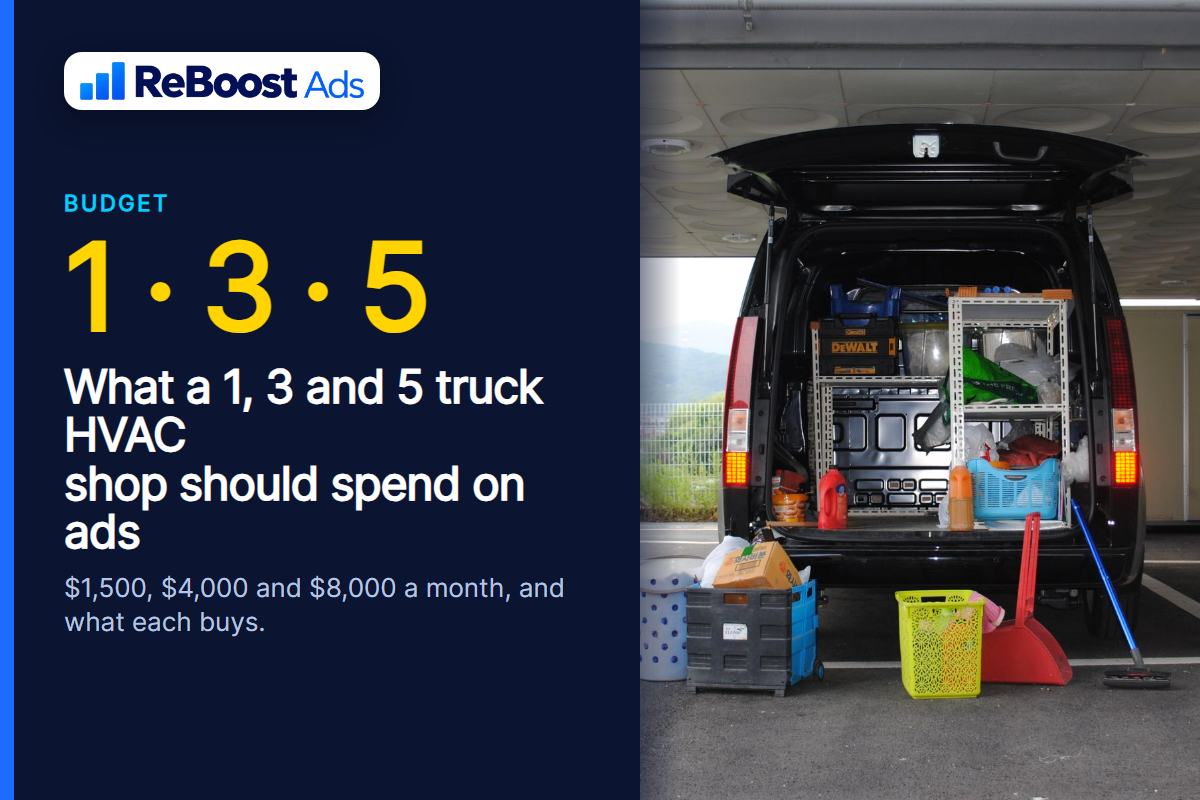
"How much should I spend on marketing?" gets the same answer from every agency: "5 to 10 percent of revenue." Which is useless when you are standing in the shop with one truck, a $1,500 a month budget, and no idea whether that buys a Google campaign, a Facebook campaign, or a very nice sign. So here is the budget by truck count, in dollars, with what each level actually buys and what it should produce.
The short answer
A one-truck HVAC shop should spend about $1,000 to $1,500 a month on ads, all on one service, and expect 8 to 15 leads and 3 to 6 booked jobs. A three-truck shop should spend $3,000 to $5,000 a month across two or three services plus retargeting and expect 25 to 45 leads. A five-truck shop should spend $6,000 to $10,000 a month with Local Services Ads, Search, Facebook and retargeting all running and expect 50 to 90 leads. In every case, keep management fees flat so the budget goes into clicks, and judge the spend by cost per booked job, not by percent of revenue.
Why "percent of revenue" is the wrong starting point
Five to ten percent of revenue is a fine answer for a $5 million company. For a $600,000 one-truck shop it says "spend $2,500 to $5,000 a month," which is more than the owner can handle in calls and more than the truck can run. The right question is backwards from capacity: how many more jobs can you actually do this month, what does a booked job cost on each channel, and how much budget gets you there. We walked through the capacity side in set an HVAC advertising budget around the jobs you can handle. This article puts the dollars on it.
The benchmark numbers used below: Google Search about $104 to $149 a lead and $300 to $400 a booked job; Local Services Ads about $51 a lead and $190 a booked job; Facebook offers about $45 to $95 a lead. (industry benchmarks, early 2026,; an industry lead-cost guide.)
ReBoost Ads does this for you.
You pick the HVAC job you want more of. ReBoost Ads builds the Google and Facebook ads and the matching landing page in your own ad accounts, our team watches them every day, and every lead goes to your phone the second it lands. Flat $197 a month right now (year-end special, normally $297), 14-day free trial, no setup fee.
One truck: $1,000 to $1,500 a month
Where it goes: Local Services Ads in your own account at a $500 to $800 cap (Google will underspend it), and one Google Search or Facebook campaign for one service at $20 to $35 a day. That is it. One service. Not five.
What it buys: 8 to 15 leads a month, 3 to 6 booked jobs at a decent booking rate. If the one service is replacements, one install pays for the quarter. If it is $89 tune-ups, the budget pays through the repairs and plans the tune-ups find.
The trap: splitting $1,200 across AC repair, furnace repair, tune-ups, replacements and duct cleaning. That is $8 a day each, one click, no data, and the conclusion that "ads don't work." Focus the money. Then the phone: at one truck the owner is usually the one answering, from a roof, which is where about one in four calls goes to voicemail. Fix that before adding a dollar; the math is in what a missed HVAC call costs.
Management: do it yourself (10 to 20 hours a month, and the nine leaks to avoid are in why your HVAC Google Ads aren't working), or a flat fee. An agency retainer at this level usually costs more than the ad spend, which is backwards.
Three trucks: $3,000 to $5,000 a month
Where it goes: LSA at $1,000 to $1,500 cap. Google Search for two services (the seasonal one and replacements) at $60 to $90 a day. Facebook for the seasonal offer at $25 to $40 a day. Retargeting at $5 to $10 a day for everyone who clicked and did not call.
What it buys: 25 to 45 leads a month, 10 to 20 booked jobs. At this level you can see cost per booked job by service and move money every month toward the winner.
The trap: the office. Three trucks means 20 to 40 calls a day, and the single dispatcher is on the other line when the second one rings. Budget for an answering setup before budgeting for the fourth campaign. A $97 a month Voice AI that books the overflow pays for itself on the first saved replacement call.
Management: this is where agencies start charging $1,500 to $2,500 a month on top of spend. (an industry lead-cost guide.) A flat $197 to $297 a month with the campaigns built and watched for you keeps the other $1,300 to $2,200 in clicks. That is 10 to 20 more booked jobs a month from the same total outlay.
Five trucks: $6,000 to $10,000 a month
Where it goes: LSA capped at $2,000 to $3,000. Search for three to four services with separate repair and install campaigns. Facebook for the seasonal offer plus a financing offer for replacements. Retargeting on both platforms. A brand campaign so competitors cannot buy your name for $2 a click. Video ads for the replacement offer.
What it buys: 50 to 90 leads a month and the data to run the business by cost per booked job per service. At this level the Monday report is a management tool, not a receipt.
The trap: percent-of-spend management. At $8,000 a month in ads, a 15 percent fee is $1,200 a month, and the agency's incentive is for you to spend $12,000. One industry guide calls percent-of-spend "the worst structure for contractors" for exactly this reason. Pay flat.
The budget rules that hold at every size
- One service per $1,000 a month of budget. Under that, campaigns starve.
- Fix the phone before adding budget. Every missed call raises the cost of every lead you buy.
- Judge at 30 days on cost per booked job. Not at 14 days on cost per click.
- Shoulder season is for tune-up and replacement offers at smaller budgets; peak season is for repair at bigger ones. Keep something running all year so the ad system never has to relearn.
- Flat management fee, your own ad accounts. Both, always.
- Raise the budget only when the booking rate holds. If leads double and booked jobs do not, the office is the bottleneck, not the budget.
What about the free stuff?
Every budget above assumes you are also doing the things that cost nothing: a same-day review text after every job, a text to past customers four times a year, this month's photos on your Google Business Profile, and a call to every open quote older than two weeks. Those are not "marketing budget," they are the reason the paid budget works. A shop with 300 reviews and a warm customer list gets more booked jobs from $1,500 than a shop with 40 reviews gets from $4,000, because the homeowner who clicks the ad sees the reviews, and the customer list fills the slow weeks the ads do not. If the free list is not done, the first $500 of any budget is better spent on an afternoon of texting than on clicks. The customer list scripts and the three-text review system are both on the blog.
A worked example: the two-truck shop in between
$2,000 a month. LSA at a $700 cap (spends about $400, 8 leads, 3 or 4 jobs). Google Search for furnace repair at $40 a day ($1,200, about 9 leads, 3 or 4 jobs). Facebook tune-up offer at $13 a day ($400, 6 leads, 3 tune-ups). Total: about 23 leads, 10 booked jobs, for $2,000 in spend plus a flat management fee. If two of the ten are replacements, the month paid for the year. That is the model.
Where ReBoost Ads fits
ReBoost Ads is the flat-fee column in every size above. You pick the service, we build the Google and Facebook ads and the landing page in your own ad accounts, watch them daily, send every lead to your phone instantly, and give you the Monday report with cost per lead by campaign. Growth at $197 a month (year-end special, normally $297) keeps a one-truck budget focused on one campaign. Pro at $297 (normally $497) runs as many campaigns as a three- or five-truck budget supports, with retargeting and the video library. Never a cut of your ad spend, no setup fee, 14-day free trial. See ReBoost Ads for HVAC, and the free HVAC cost-per-lead calculator will turn your ticket sizes into the budget that makes sense before you spend it.
Put it to work
How to set an HVAC marketing budget from capacity
Count the jobs you can add
How many more jobs of which service the trucks can actually do this month.
Price a booked job per channel
Use benchmarks until you have your own: about $190 for Local Services, $300 to $400 for Search, $120 to $250 for Facebook offers after booking.
Multiply and focus
Jobs wanted times cost per booked job is the budget. One service per $1,000 a month.
Fix the phone, then judge at 30 days
Answer rate first, then cost per booked job by channel, then move money toward the winner.
Common questions
Frequently asked questions
How much should a one-truck HVAC company spend on marketing?
About $1,000 to $1,500 a month in ad spend: Local Services Ads at a $500 to $800 cap plus one Google Search or Facebook campaign for one service at $20 to $35 a day. Expect 8 to 15 leads and 3 to 6 booked jobs. Do not split it across five services.
Is 5 to 10 percent of revenue the right HVAC marketing budget?
It is a rough guide for larger companies, not a plan. For a small shop, budget from capacity instead: how many more jobs you can do this month, what a booked job costs on each channel, and how much spend gets you there.
Should HVAC companies pay agencies a percentage of ad spend?
No. A percentage fee rewards the agency for making you spend more. Pay a flat fee so the rest of the budget goes into clicks. At $8,000 a month in spend, 15 percent is $1,200 a month that could be buying leads.
How many leads should an HVAC marketing budget produce?
Using 2026 benchmarks, about $104 to $149 per Google Search lead, $51 per Local Services lead and $45 to $95 per Facebook lead: roughly 8 to 15 leads per $1,500, 25 to 45 per $4,000 and 50 to 90 per $8,000, before the phone and booking rate take their cut.
When should an HVAC company raise its ad budget?
When the booking rate holds as leads grow. If leads double and booked jobs do not, the office is the bottleneck, not the budget. Judge at 30 days on cost per booked job and raise in steps.